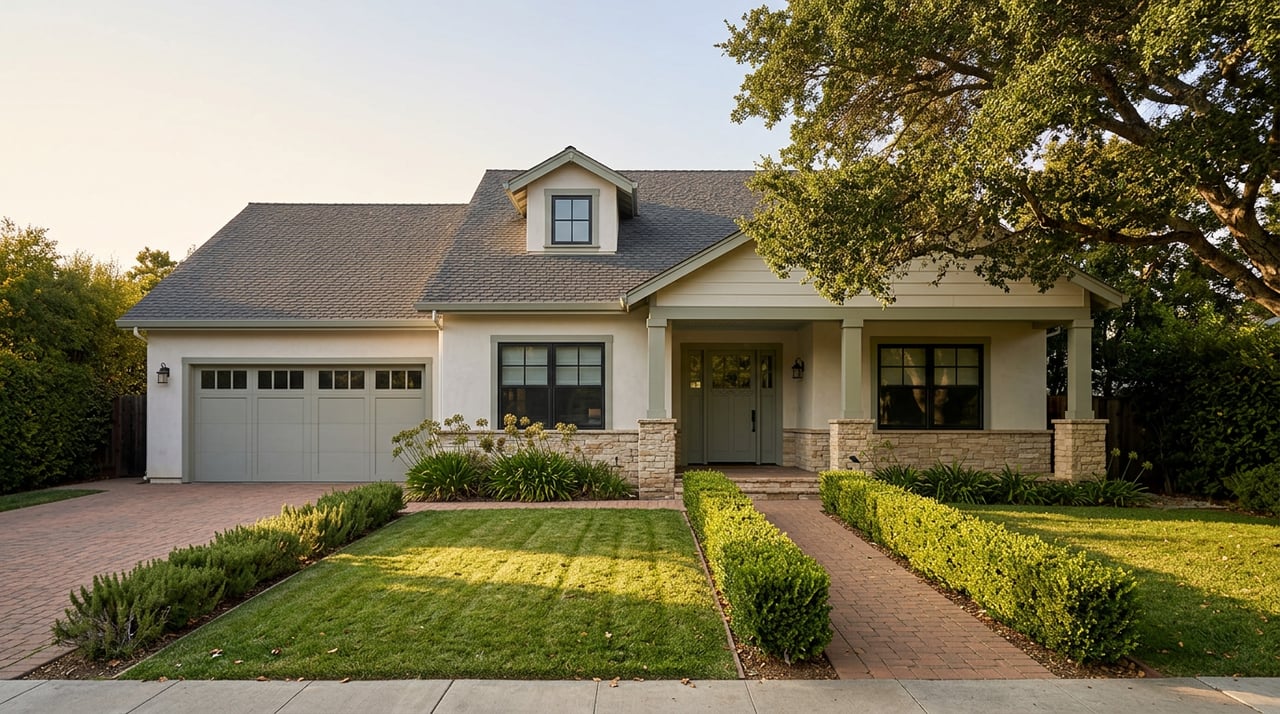
Why Cypress Is Steering Its New Housing to the Old Racetrack, Not Lincoln Avenue
September 24, 2026
September 24, 2026
If you are cross-referencing Cypress against Cerritos or Buena Park while you shop for a house, you have probably run into the same headline more than once: California is requiring cities to plan for thousands of new homes over the next several years. What that headline never tells you is where those homes actually land inside a given city, and in Cypress the answer says more about how this town works than any zoning map does on its own.
Almost 2,000 of Cypress's new state-mandated housing units are being routed to one property: the old Los Alamitos Race Course site at Katella and Lincoln. Not to the commercial strip along Lincoln Avenue that already has the restaurants, the traffic, and the retail frontage you would expect to absorb that growth. The reason has less to do with planning philosophy than with who owns the dirt.
Walk Lincoln Avenue today and you will see steady, small-scale investment. Ichitaru Ramen went before the Cypress City Council in March 2026 for a 943 square foot expansion into an adjacent tenant space, growing from 1,062 to 2,005 square feet. OC Bottle Shop cleared a similar hearing in February 2026 for an 869 square foot addition. Both sit inside the Lincoln Avenue Specific Plan's Commercial Mixed Use District, and both needed a dedicated city council hearing to add what amounts to a spare bedroom's worth of floor space.
That pattern is not a coincidence. Lincoln Avenue is cut into dozens of small, separately owned parcels, so growth there arrives one lease and one conditional use permit at a time. Meanwhile, California's Regional Housing Needs Allocation process required Cypress to plan for a total of roughly 4,259 new housing units over this planning cycle, according to the impartial ballot analysis prepared for city voters. Some of that number was always going to fall on Lincoln Avenue. The rest needed a home somewhere else.
Voters answered the question in November 2024 with Measure S, which adopted the Cypress Town Center and Commons 3.0 Specific Plan for the old racecourse property. Before the vote, that site was capped at 1,250 units under the prior plan, of which 135 had already been built. Measure S raised the cap to 1,926, a jump of 676 units that the city's own housing planning had originally expected to distribute along Lincoln Avenue instead.
A draft environmental review filed with the state in April 2025 lays out what that buildout could look like in practice: up to 1,791 residential units, as much as 480,000 square feet of non-residential space, roughly 11 acres of new public park land, an extension of Moody Street from Cerritos Avenue through to Katella Avenue, and a new intersection where Vessels Circle meets that extended street. None of it has broken ground yet. As of this fall, the project is still working through entitlements, and the city council has a hearing scheduled for October 13, 2026 to consider a Park Development Fee Nexus Study and a new Park Impact Fee Ordinance, the kind of financing groundwork cities put in place shortly before a large master-planned buildout actually starts pouring concrete.
Here is the part that matters if you are trying to read this market rather than just skim it. The racecourse property has one owner. Lincoln Avenue has many. A city trying to hit a state housing number in a hurry will almost always find it easier to negotiate one large deal with one landholder than to assemble consent, financing, and construction timelines across a dozen separate storefronts.
That does not mean Lincoln Avenue is frozen out of new construction entirely. The city's own list of notable development projects includes Madera Walk, a housing project at 4782 Lincoln Avenue built by a single builder who assembled enough contiguous land to make a real project pencil out. It is proof that big new construction can happen on that corridor. It also shows why it happens less often there than it does on a property that was already consolidated under one owner. Around the same corridor, roughly 25 acres formerly used by Yamaha Motor Corporation has reportedly come up for redevelopment consideration too, another example of a large, single-owner holding with the kind of scale that fragmented Lincoln Avenue parcels rarely offer on their own.
The lesson for anyone comparing neighborhoods: in a market where cities are under pressure to add housing quickly, watch who owns the big parcels, not just what the zoning map allows. Zoning tells you what could theoretically happen. Ownership tells you what will actually get built first.
Not everyone in Cypress was on board with routing growth this way, and the disagreement is worth understanding because it explains a piece of infrastructure you will hear about if you buy near Katella or Cerritos in the coming years. A local civic group, Citizens for Responsible Government in Cypress, argued against extending Moody Street through to Katella Avenue, worried it would turn a quiet residential street into a through corridor and add traffic near local schools.
The counterargument, laid out in public commentary responding to that concern, is more of a logistics problem than a philosophical one. The town center property has no frontage on any primary or secondary arterial street. Without the Moody Street connection, the site would have no direct link to a major road at all, which would make it harder for any retail built there to draw the kind of foot traffic that made a project like The Square shopping center work elsewhere in Cypress. Whichever side of that debate you land on, it explains why Moody Street shows up repeatedly in the planning documents. It is not a cosmetic detail. It is the access point the entire buildout depends on.
If you are drawn to Cypress because you want to be near whatever comes next, the Katella and Cerritos corner near the old racecourse is the part of the city to watch. It is where the park acreage, the new commercial square footage, and the bulk of new-construction inventory are headed, though nothing there has a confirmed groundbreaking date yet. The October park fee hearing is a signal the city is setting up financing ahead of construction, not proof that shovels are close.
If instead you are drawn to Cypress for the established, lower-turnover single-family streets away from Lincoln Avenue, very little about this changes your day to day life anytime soon. Lincoln Avenue will keep evolving the way it has been, a few hundred square feet at a time, one restaurant or convenience store at a hearing.
None of this tells you whether now is the right time to buy or what a specific block is worth. It does tell you something a median price chart cannot: where the next wave of construction, park space, and traffic pattern change in Cypress is actually headed, and why.
When will construction start at the old racecourse? There is no public start date yet. The project is still moving through state environmental review and city entitlements, and the October 2026 hearing on park impact fees is a step toward financing infrastructure, not a groundbreaking announcement.
Will Lincoln Avenue ever see large new construction, or just small storefront changes? Both. Most activity there continues to be incremental, permit by permit. Projects like Madera Walk show that larger new construction is possible on that corridor when a builder can assemble enough contiguous land first, which simply takes longer than working with a property that already has one owner.
Does any of this affect what a Cypress home is worth today? This is a question about geography and timing of future construction, not a current valuation. If you want to talk through what proximity to the coming buildout might mean for a specific street or price range, that is a conversation worth having with someone who tracks these filings as they happen.
Cypress is working through a real shift in where its growth is headed, and the paperwork behind that shift is public but not exactly light reading. If you are comparing Cypress to other Orange County cities and want help translating what these plans mean for a specific street or a specific decision, Gina Oddo can walk through it with you. Let's Connect.
Stay up to date on the latest real estate trends.
My Hometown is Changing
Whether you're buying your first home, selling a longtime property, relocating, or exploring an investment opportunity, Gina Oddo offers the knowledge, strategy, and personal attention to help you move forward with confidence. Her approach is simple: listen first, provide honest guidance, create a clear plan, and stay by your side from the first conversation through closing.
(714) 348-3820
[email protected]
1400 N HARBOR BLVD STE 720
FULLERTON, CA 92835